

Exploring Second Life
Mainland continents, ancient regions, haunted hotels, and the art of getting wonderfully lost in a world that never stops changing.

There’s a peculiar magic in opening the map of Second Life for the first time. Unlike the tidy grids of most virtual worlds, SL’s geography grew organically — region by region, continent by continent — mirroring the chaotic creativity of the thousands of people who built it. This article is your guide to navigating that geography, starting from the very beginning: a single region named after a street in San Francisco.
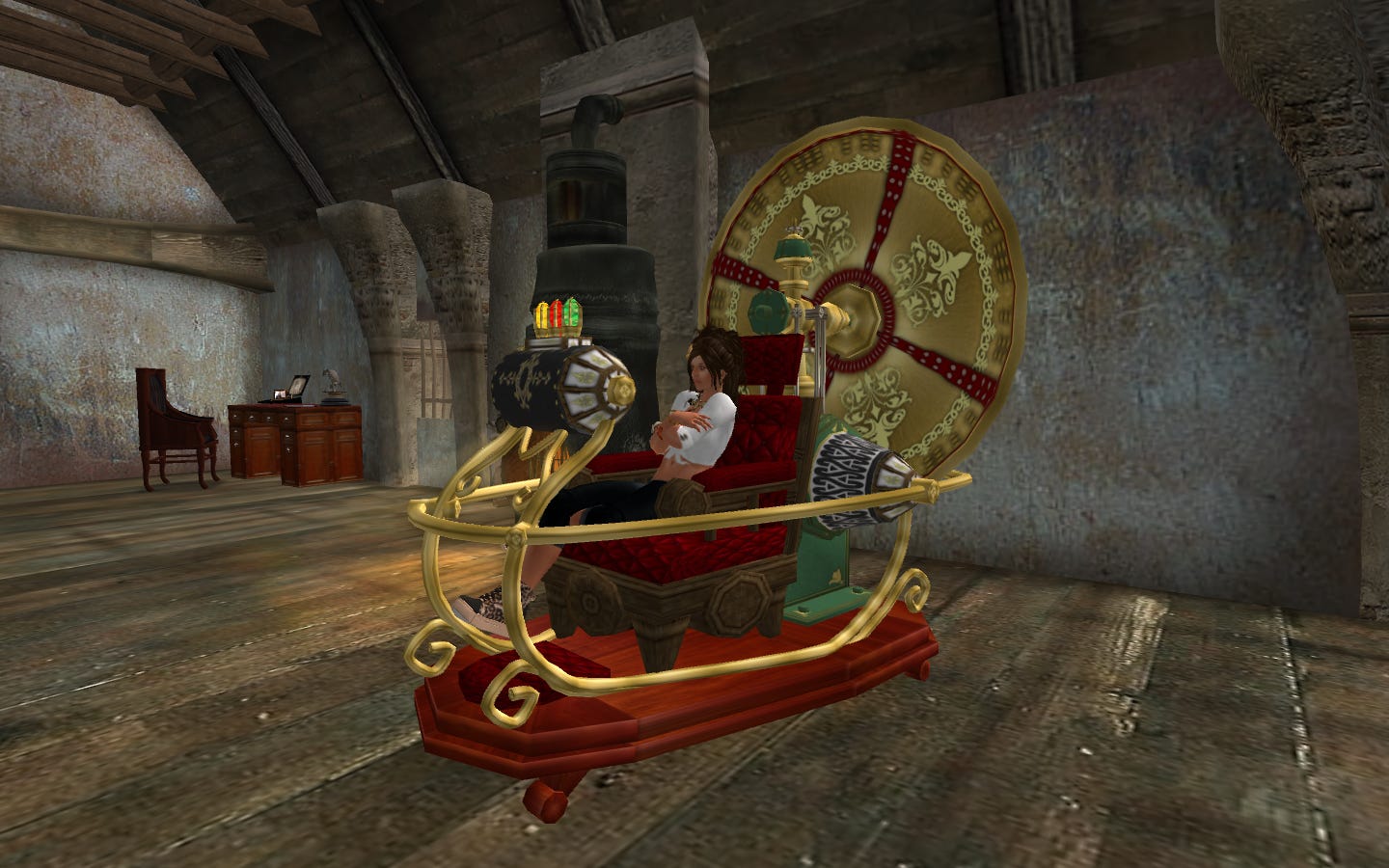
Da Boom — Where It All Began
To understand Second Life’s geography, you have to go back to 1999 — before SL even existed. Philip Rosedale (known in-world as Philip Linden), founder of Linden Lab, had a vision: a vast, continuous virtual field distributed across multiple servers, where residents could build and inhabit an ever-evolving world.
That vision became Linden World in 2001, which was renamed Second Life when its developers searched for a name to capture the expansive, always-changing nature of what they were creating.
On March 13, 2002, Steller Sunshine became the first avatar resident of Second Life — building Governor Linden’s mansion and a treehouse, and setting the tone for everything that followed.
The word Avatar itself comes from the Sanskrit Avatāra — ‘descent,’ as in a deity descending to the earthly spheres. In SL, your avatar is simply who you are in that world. Human, furry, robot, demon, child, abstract object: the only constraint is imagination.
After a beta period, Second Life officially launched in June 2003. Those first sixteen regions took their names from streets in San Francisco — the same city where Linden Lab’s first offices stood on Linden Street. The first region was Da Boom (a nod to De Boom Street, and a wink at the Big Bang). The others: Clara, Clyde, Federal, Freelon, Hawthorne, Minna, Natoma, Ritch, Shipley, Stanford, Stillman, Taber, Varney, Welsh, and Zoe. All sixteen remain active today.
Together, they formed the seed of SL’s first continent: Sansara — Sanskrit for ‘ever-changing world.’
A Swarm Of Interconnected Regions
Since Sansara’s creation, Second Life’s territory has never stopped growing or shifting. Philip Rosedale’s original vision materialized into a sprawling network of contiguous regions forming distinct continents — each with its own aesthetic identity, rules, and character.
These fall into two broad categories:
Mainland Continents — Linden-owned land, open and often delightfully chaotic.
Private Continents — user- or community-owned regions offering themed environments, stricter covenants, and more cohesive aesthetics. Caledon-Winterfell (the oldest private continent) and the Blake Sea are prime examples.
This article focuses on Sansara — the oldest mainland continent — and a handful of its most remarkable places. There’s far too much to cover in one piece, so consider this the first of several dispatches from the oldest corners of the grid.
Sansara — The Ever-Changing World
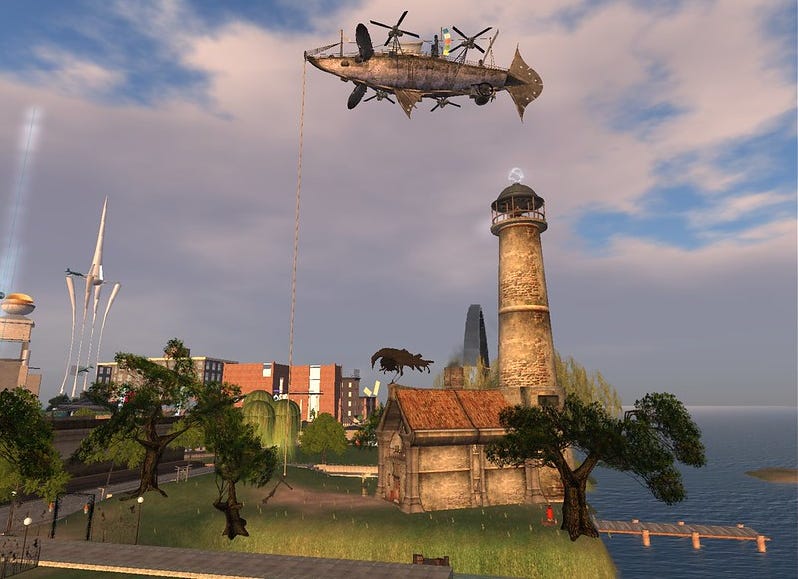
From those original 16 regions, Sansara (transitory name C001), has grown to 981 — covering roughly 64 square kilometers of virtual terrain. It has roads, urban streets, autonomous trams, railways, coastlines, and vast stretches of navigable open water. It also has Yava Script Pods — automated, convertable, scheduled vehicles that can be seen on many continents across Second Life; compared with other automated vehicles, they are much more safe and still they allow passenger to control a few functions (like speed). In Sansara they operate from its Snowland base at region Durango, but you can easily board a Pod by clicking (sit) on it as soon as you’re close enough.
The fact that Yava Script Pods give touristic information on the way is very important and helps people learn much about Second Life geography and history. All its bases in Sansara and Heterocera have connections with the SLGI Trains.
Remarkably, over 90% of Sansara is explorable without teleportation. You can simply walk, drive, sail, or fly from one end to the other. It connects to the north via the ANWR Channel — Arctic National Wildlife Refuge — to the Heterocera (Atoll) Continent, and more recently to Bellisseria, SL’s Linden Homes continent, from the southeast and northeast (more on that in a future article).
Sansara is the kind of place where you set out to visit one landmark and end up discovering three others you’d never heard of. That’s the magic of it.
Nova Albion — The Old World
My first recommended stop: Nova Albion — Second Life’s very first city. I’ve always called it ‘Little Italy,’ partly for the names of its four regions (Barcola, Grignano, Miramare, Sistiana) and partly because it’s long been home to a warm community of Italian residents.
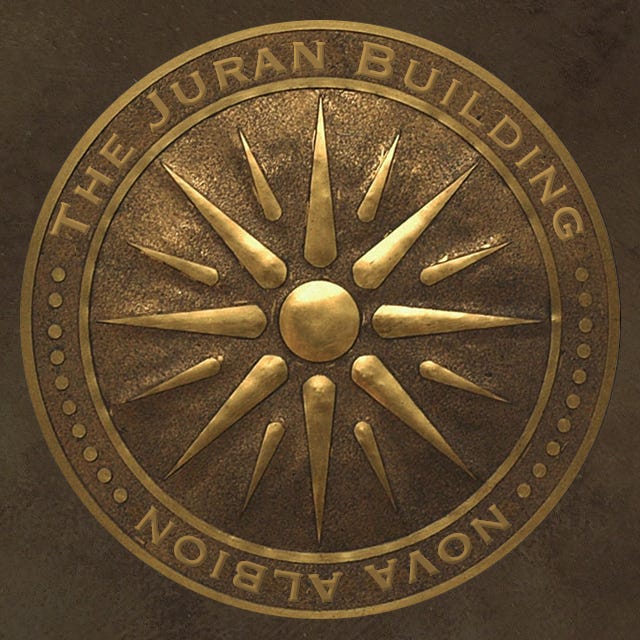
Nova Albion holds a special place in my SL history. During 2013–2014, it was essentially my first home in the virtual world. My business partner Golden and I ran a jazz pub in Barcola, and I had an apartment in Sistiana — borrowed from my generous friend Lorna — in the now-derezzed Juran Building, built by Lisa Juran, perched across from the South Channel.
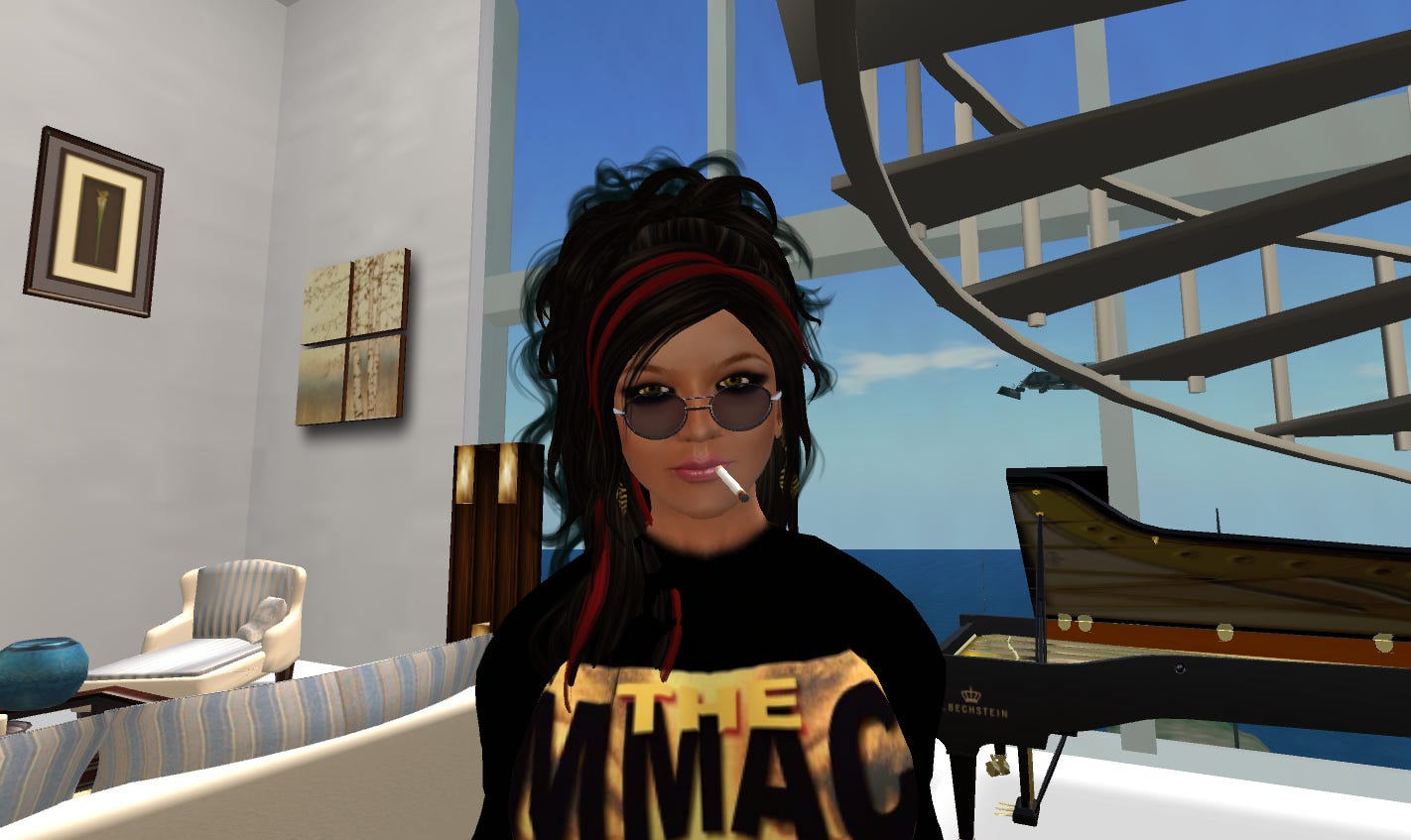
The city is easily traversable on foot or by tram. An autonomous tram line connects the Luna commercial area (site of SL’s first-ever mall) to the Dore Infohub — a social hub where new and veteran residents mingle, surrounded by information kiosks. Dore’s infohub is in the convergence point of four regions and four infohubs simultaneously, joining those of Ahern, Bonifacio and Morris.
Don’t miss these landmarks while you’re there:
The Metaharpers’ Theater in Miramare — where, I’ll admit with some pride, my own metaharp is on display.
The Barcola Infohub — Nova Albion’s main tram station, with a charming pedestrian bridge topped by a map of the city.
The SLOPCO refinery (Second Life Oil & Petroleum Company) — an atmospheric relic of SL’s industrial imagination.
The north bridge crossing the Straits of Shermerville — that connects Nova Albion with the Shermerville town.
And just following the west bridge from Sistiana, an island with a dreadful building, the Channel Island Mental Hospital, a haunted abandoned asylum that I can only describe as genuinely terrifying. Visit at your own risk.
Bay City — An Urban Experiment
Cross the west bridge and you’ll arrive at Bay City — built as Second Life’s first deliberate urban planning experiment, and still one of its most ambitious.
Bay City has it all: a network of autonomous trams crisscrossing the city, internal canals with drawbridges, small ferries and catamarans plying the waterways, Hau Koda International Airport for aerial arrivals, and a Moose Beach infohub where the community gathers.
At the centre of Bay City, where the Falmouth and Bourne regions meet, a bridge marks the boundary — and on an island nearby sits a darkly magnificent Art Deco building, the haunted Falmouth Hotel. I recommend it only to those with steady nerves.
Bay City deserves its own article (or several). For now, the Second Life Wiki covers it well: secondlife.fandom.com/wiki/Bay_City
Snowlands — My Alpine Refuge
In the southern reaches of Sansara lies Snowlands — a subcontinent unto itself, perpetually blanketed in white, with a landscape that genuinely evokes the Alps.
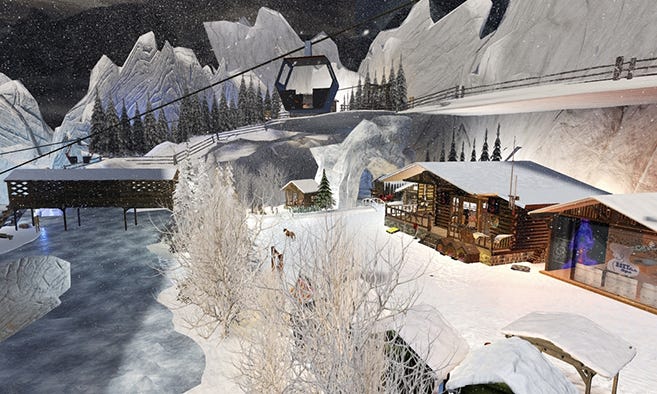
Snowlands has several aerodromes (like Kania and Minarlo Vite), a frozen lake at Zermatt where you can ice skate, an autonomous railway — the Okemo Nakiksa Southern Railway (ONSR), a solid road network, and multiple ski areas. The crown jewel is Chamonix City in the far west: a fully realized alpine resort with all the features you’d expect — and a few you wouldn’t.
I lived in Snowlands for over two years. I explored nearly every corner of it, and I can say with confidence that its geography is some of the most immersive in all of Second Life. The details I gathered there — and the experiences I had — are ones I still carry.
The Ivory Tower — Prim Torturers
No tour of Sansara is complete without The Ivory Tower - Library of Primitives, located in Natoma — one of those original sixteen regions.
Before the overwhelming incursion of mesh objects (courtesy of 3D programs like Blender), ‘prims’ were the building blocks of everything in Second Life. The Ivory Tower is an exhaustive, lovingly maintained library of what you can do with them — twisting and stretching basic shapes into surprisingly complex forms. Builders used to call it ‘tortured prims,’ and at the Ivory Tower you’ll learn everything about it.
It also has a publicly accessible sandbox — perfect for trying things out immediately after you’ve learned them.
This is Just the Beginning
Sansara alone could fill a book. I haven’t yet touched the ‘color sims’ with the Great Second Life Railway (GSLR), most historical region areas, or the many quiet corners I’ve stumbled across over years of wandering. Those will come in future articles.
If you aren’t yet in Second Life, I hope this gives you a sense of just how deep the rabbit hole goes — and a few coordinates to start exploring. If you’re already a resident, I’d love to know which corners of Sansara (or anywhere else in SL) hold a special place for you.
The grid is vast, and the map is only a suggestion. Get lost. That’s where the best discoveries happen.
Useful Resources
World Map of Second Life: maps.secondlife.com
Official SL Wiki — List of Continents: wiki.secondlife.com/wiki/List_Of_Continents
Second Life Knowledge Base: community.secondlife.com/knowledgebase/english/
Sansara Wiki (Second Life Geography Institute — SLGI): https://slgi.fandom.com/wiki/Sansara
Bay City Wiki: secondlife.fandom.com/wiki/Bay_City
If this resonated with you — follow, subscribe, like, repost, share.
It’s always free, and it helps more people discover Second Life.
Even though my Substack content is free, if you’re so inclined,
support is always appreciated:
The articles you are publishing Sulvina are so informative and interesting. They are helpful in not only sharing interesting information about our wonderful virtual world, but also promoting and encouraging exploration. I plan to share links to these articals with new residents and long time SLers.
Great work! Your efforts are appreciated.
This article is very good - it gives a lot of insight what even longterm residents dont know.
Well done, Silvina :)